Monday, September 29, 2008

Latinos in Scotland

I am writing this post a little late after our trip, but better late than never.

Just before the start of the school year, my wife and I made a 10-day trip to Scotland. She was presenting at an invitation-only conference in Glasgow (I wasn't invited but came along anyway).

We decided to document our trip in "realtime" (or close to it) by maintaining a 'geo-blog' of our travels for friends and family back home. This was an interesting - and time consuming - experiment. Scotland is a 21st century country (technically it is part of the UK, but the relationship is complicated), but it is also a still a rural country. Finding a stable Internet connection was almost always a challenge.


View Larger Map

An interesting thing about the state of online maps and directions. We discovered - the hard way - that Google Maps consistently underestimates travel times in Scotland. By contrast, Multimap (a British product) provides much more accurate estimates of travel time. Google has a national bias (surprise, surprise), or at least it doesn't take into account the unique quality of British roads or hapless American tourists trying to drive on the left side of the road. The difference was significant and we nearly missed a crucial connection on a car ferry. Luckily, the Scottish people are very forgiving.

Edinburgh is suitably beautiful and romantically Gothic - thick walled castles on craggy peaks dripping with damp and history. The newer buildings (those less than 300 years old) are still black and sooty from the city's coal-fired past.


We were warned that Glasgow would be a gritty contrast (and a waste of time), but I found it to be easily as engaging as Edinburgh. I spent 3 full days walking that city. Where Edinburgh is a beautifully preserved museum, Glasgow is a living, breathing, frenetic metropolis. Many of the buildings are products of the city's wealthy heyday - the mid to late 19th century. High Victorian architecture and a strong Gothic revival - flying buttresses, extraordinary gargoyles and grotesques, incredibly carved, multi-hued stone. And inside and all around this 19th century architecture flows the modern day Scotland - well dressed people occupied with modern pursuits. Lots of good 'ethnic' restaurants too.



Modern day Scotland is a bundle of contrasts. Our visit to Eilean Donan, one of the most beautiful and charismatic castles, provided a jarring example. While the local guide (dressed in full kiltish reglia) explained the fairytale-like saga of clan battles and rediscovered histories, the reality is that much of the surrounding lands are now owned by Saudi families (why, I don't know).


The Highlands were breathtaking. Treeless and green. The Highlands are a region of long, unbroken views, low skies, and steep-sided giants. "Moody" is a cliche description I've often heard, but now I understand. It's not just the constant damp and cloudiness, it's also the consistently unpredictable light. Clouds and mist move and shift with eerie speed.


Must go back.

Sunday, June 22, 2008

Geography in Nebraska

I spent this last week at the University of Nebraska in Lincoln, Nebraska (Go Big Red!) scoring Advanced Placement Human Geography exams. I personally scored 400 exams. I was accompanied by another 200+ high school teachers and college professors, and together, we scored 40,000 exams from high schools across the country and around the world. This was my first year scoring high school AP exams, but the AP Human Geography exam has been around for 8 years now, and the number of students taking the exam has been doubling every two years!

Until I had signed up to be an AP reader, I was not even aware that high schools taught AP Geography in the US. It turns out that there are hundreds of high schools around the country that offer formal Geography courses either as electives, or in some cases, required courses! High school students who achieve a minimum score on the AP Human Geography exam can get college credit (and thereby have one less course to take).

Geography is not a required course in Massachusetts high schools, nor is it commonly offered. That could be changed. Imagine how much easier it would be to recruit Geography majors if students were already aware of Geography as a discipline before they got to college.

Wednesday, June 4, 2008

Trust Me, I'm a Scientist

An article in the Boston Globe describes a study done by physicists at Northeastern University in which they surreptitiously tracked the movements of 100,000 cell phone users in some undisclosed "industrial nation" in order to look for patterns in peoples' day-to-day movements (see "Study Secretly Tracks Cell Phone Users Outside US" Globe 6/4/2008). The results of their analysis were published in Nature, a highly prestigious science journal. It is disturbing that neither the Northeastern researchers nor the editors at Nature seems to have thought through the ethical questions of this kind of study. The authors admit that they did not consult with an ethics panel.

Most, if not all, institutions of higher learning, as well as many private institutions, maintain some kind of Institutional Review Board (IRB). The purpose of an IRB is to ensure that any research done by the members of an institution (e.g., faculty, students, researchers) is conducted responsibly and ethically, so as not to cause injury, harm, or undue risk (physical, mental, economic, legal, etc.) to humans and even animals. Under federal law, institutions receiving federal funds must in fact maintain an IRB to review research on human subjects - whether medical or behavioral.

These requirements for ethical review are rooted in past abuses. The most notorious include the experimentations done on humans by Nazi physicians during World War II. In the U.S., biomedical researchers are still haunted by the Tuskegee Syphilis Study, in which Public Health Service researchers withheld medication from patients with syphilis in order to observe the effects of the disease when left untreated. The latter study did not end until it was revealed in 1972. Unfortunately, there are numerous examples of unethical research that have resulted in physical, psychological and even social harm.

Having served on Salem State's IRB, I know that most of the day-to-day work of an IRB is simply determining whether or not a proposed form of research even warrants scrutiny; most do not. However, the point is that it is the responsibility - the prerogative - of the IRB to make that determination. The IRB is an institutional safeguard to catch problems before they develop. Any research involving the collection of sensitive information from or about living persons should pass before the IRB just to make sure.

A spokesman for the Federal Communications Commission pointed out that the kind of 'nonconsensual' tracking done by the Northeastern researchers is in fact illegal in the US. It is illegal in other countries as well. The Nature News article notes that another researcher working on very similar research was not able to do what the Northeastern researchers had done specifically because it was illegal in Germany, where he was based. However, the Northeastern study discloses neither the country in which the study was conducted, nor the cell phone company that supplied the data.

Cesar Hidalgo, a Northeastern physics researcher and coauthor of the study, said, "In the wrong hands the data could be misused ... But in scientists' hands you're trying to look at broad patterns.... We're not trying to do evil things. We're trying to make the world a little better."

Without transparent processes or institutional safeguards, however, such assurances must be suspect.

Friday, April 18, 2008

Food, the Environment and Justice

This year's theme for Earth Days at Salem State College was "Food, the Environment and Justice." It was a timely theme. Debates over the impacts of ethanol fuel production on food availability and habitat around the world, the threat of hunger from sky rocketing food prices, anxiety over genetically modified organisms, increasing concern over globalized food distribution networks with minimal accountability and maximum distance, have made food a prominent concern within environmental and political and energy and economic debates, to name only a few domains.

The Earth Day celebration is nearly four decades old now, and it has served as an opportunity to celebrate the importance of a healthy Earth. At SSC, Earth Day has also served as a unique opportunity to bring the academic community together around a common cause. On Monday, April 14, 2008, over 100 students displayed 80 posters on an incredible array of topics. Equally impressive, we had 32 faculty from 10 different disciplines acting as poster judges, as well as over 30 members on the non-campus community. For the second year in a row, Earth Days at SSC also featured a juried art exhibit - hence the killer tomato.

The next day Professor Jamie Wilson and I hosted a viewing of the documentary King Corn on Central Campus. Student attendance wasn't as good as we would have liked, BUT we had unexpected visitors. Becky Ellis, the aunt of Ian Cheney (co-producer and co-star of King Corn), came to the viewing with a friend. She lives in Marblehead. Very pleasant woman. We had a great discussion after the film. She suggested that we contact Ian because he lives in Boston. Excellent idea.

Sunday, April 6, 2008

Touring Our Backyard


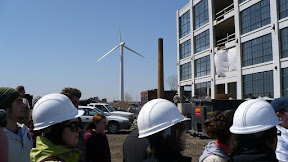
For the fourth year in a row, students from Renaissance College at the University of New Brunswick and students from the Department of Geography at Salem State College came together for a common experience. This year it was Salem's turn to host a visit for our Canadian colleagues. And this year, our group was taken on an Environmental Justice tour of Chelsea, Massachusetts. Roseann Bongiovanni, Chelsea City Councilor and Associate Executive Director of The Chelsea Collaborative, acted as our guide and host.

Chelsea is less than 15 miles from Salem, but it might as well be on the other side of the country. Chelsea is a small city - only 1.8 square miles - but this small city shoulders a heavy burden for the region.

Chelsea is host to over 70% of New England's heating fuel, 100% of the jet fuel for nearby Logan International Airport, a literal (uncovered) mountain of road salt for over 200 New England cities and towns, oil storage tanks holding 22 billion gallons of oil, and countless other environmental insults. Chelsea is a lower income community with a large population of immigrants and minorities. The concentration of environmental burdens and the lower socioeconomic status of its residents are not random coincidence. This is a pattern repeated throughout the country.

Roseann led our busload of 40 students and faculty throughout the city while she narrated about the social and environmental challenges that this small city and its residents have faced, today and in the past. But it hasn't been all woe and disappointment. In fact, Chelsea residents have been increasingly active in taking control of their city. The Chelsea Collaborative has organized the community to demand more responsible behavior by its corporate neighbors, and pushed for fairer treatment by those who would otherwise take advantage.

Last year, Energy Management Inc. (EMI) proposed the construction of a diesel-fired peaking power plant in Chelsea - across the street from the Burke Elementary School complex which houses four schools and more than 1,300 students. Aside from insult, the irony/hypocrisy of this proposal is that EMI has simultaneously been struggling to locate the nation's first offshore wind farm off the coast of Cape Cod and Nantucket. While the nation's wealthiest (e.g., Kennedys) have raged against the installation of renewable, clean energy, Chelsea gets an old-fashioned fossil-fueled power plant. However, Chelsea residents did not take this lying down. After months of aggressive and strategic organizing and demonstrating, EMI was forced to withdraw its proposal (see "Power Plant Withdraws, City Cheers," Boston Globe 11/18/2007).

While Chelsea remains a largely industrial and working class city, changes are afoot. Roseann arranged for our group to visit the Forbes Park project (still under construction). Blair, the project developer, conducted this leg of our tour. Forbes Park will be a 'green' loft community built atop what used to be an old lithograph factory. Complete with its own wind turbine, restored marshlands, and naturally insulated lofts (no need for air conditioning), it promises to introduce a new level of sustainable development. Of course, these lofts will be largely out of reach for most Chelsea residents - prices beginning in the $300,000 range. Students picked up on this issue fairly quickly.

When the tour was complete, we headed back to Salem to regroup and discuss what we had experienced. Students had been previously assigned to various stakeholder groups (i.e., developers, government officials, community residents, etc.) and were asked to consider Chelsea's issues from their respective positions. The discussion was interesting - students picked out the complicated, seemingly intractable issues facing the city. However, finding problems is always easier than finding solutions. It's important to remember that despite numerous obstacles, residents have battled the odds and made progress. This is one of the things that made our tour particularly powerful - not just an exposure to depressing problems in a marginalized community, but a tour of an ongoing project to make things better.