Friday, April 18, 2008

Food, the Environment and Justice

This year's theme for Earth Days at Salem State College was "Food, the Environment and Justice." It was a timely theme. Debates over the impacts of ethanol fuel production on food availability and habitat around the world, the threat of hunger from sky rocketing food prices, anxiety over genetically modified organisms, increasing concern over globalized food distribution networks with minimal accountability and maximum distance, have made food a prominent concern within environmental and political and energy and economic debates, to name only a few domains.

The Earth Day celebration is nearly four decades old now, and it has served as an opportunity to celebrate the importance of a healthy Earth. At SSC, Earth Day has also served as a unique opportunity to bring the academic community together around a common cause. On Monday, April 14, 2008, over 100 students displayed 80 posters on an incredible array of topics. Equally impressive, we had 32 faculty from 10 different disciplines acting as poster judges, as well as over 30 members on the non-campus community. For the second year in a row, Earth Days at SSC also featured a juried art exhibit - hence the killer tomato.

The next day Professor Jamie Wilson and I hosted a viewing of the documentary King Corn on Central Campus. Student attendance wasn't as good as we would have liked, BUT we had unexpected visitors. Becky Ellis, the aunt of Ian Cheney (co-producer and co-star of King Corn), came to the viewing with a friend. She lives in Marblehead. Very pleasant woman. We had a great discussion after the film. She suggested that we contact Ian because he lives in Boston. Excellent idea.

Sunday, April 6, 2008

Touring Our Backyard


For the fourth year in a row, students from Renaissance College at the University of New Brunswick and students from the Department of Geography at Salem State College came together for a common experience. This year it was Salem's turn to host a visit for our Canadian colleagues. And this year, our group was taken on an Environmental Justice tour of Chelsea, Massachusetts. Roseann Bongiovanni, Chelsea City Councilor and Associate Executive Director of The Chelsea Collaborative, acted as our guide and host.

Chelsea is less than 15 miles from Salem, but it might as well be on the other side of the country. Chelsea is a small city - only 1.8 square miles - but this small city shoulders a heavy burden for the region.

Chelsea is host to over 70% of New England's heating fuel, 100% of the jet fuel for nearby Logan International Airport, a literal (uncovered) mountain of road salt for over 200 New England cities and towns, oil storage tanks holding 22 billion gallons of oil, and countless other environmental insults. Chelsea is a lower income community with a large population of immigrants and minorities. The concentration of environmental burdens and the lower socioeconomic status of its residents are not random coincidence. This is a pattern repeated throughout the country.

Roseann led our busload of 40 students and faculty throughout the city while she narrated about the social and environmental challenges that this small city and its residents have faced, today and in the past. But it hasn't been all woe and disappointment. In fact, Chelsea residents have been increasingly active in taking control of their city. The Chelsea Collaborative has organized the community to demand more responsible behavior by its corporate neighbors, and pushed for fairer treatment by those who would otherwise take advantage.

Last year, Energy Management Inc. (EMI) proposed the construction of a diesel-fired peaking power plant in Chelsea - across the street from the Burke Elementary School complex which houses four schools and more than 1,300 students. Aside from insult, the irony/hypocrisy of this proposal is that EMI has simultaneously been struggling to locate the nation's first offshore wind farm off the coast of Cape Cod and Nantucket. While the nation's wealthiest (e.g., Kennedys) have raged against the installation of renewable, clean energy, Chelsea gets an old-fashioned fossil-fueled power plant. However, Chelsea residents did not take this lying down. After months of aggressive and strategic organizing and demonstrating, EMI was forced to withdraw its proposal (see "Power Plant Withdraws, City Cheers," Boston Globe 11/18/2007).

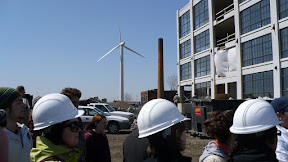
While Chelsea remains a largely industrial and working class city, changes are afoot. Roseann arranged for our group to visit the Forbes Park project (still under construction). Blair, the project developer, conducted this leg of our tour. Forbes Park will be a 'green' loft community built atop what used to be an old lithograph factory. Complete with its own wind turbine, restored marshlands, and naturally insulated lofts (no need for air conditioning), it promises to introduce a new level of sustainable development. Of course, these lofts will be largely out of reach for most Chelsea residents - prices beginning in the $300,000 range. Students picked up on this issue fairly quickly.

When the tour was complete, we headed back to Salem to regroup and discuss what we had experienced. Students had been previously assigned to various stakeholder groups (i.e., developers, government officials, community residents, etc.) and were asked to consider Chelsea's issues from their respective positions. The discussion was interesting - students picked out the complicated, seemingly intractable issues facing the city. However, finding problems is always easier than finding solutions. It's important to remember that despite numerous obstacles, residents have battled the odds and made progress. This is one of the things that made our tour particularly powerful - not just an exposure to depressing problems in a marginalized community, but a tour of an ongoing project to make things better.

Wednesday, March 19, 2008

The Artwork of Science

On Tuesday, March 18, 2008, our own Dr. Stephen Young opened a unique art exhibit entitled "Earth Exposed" at the Winfisky Gallery at Salem State College. The exhibit features a wide array of aerial and satellite-based imagery of the earth, from urbanized, coastal Salem, to the so-familiar arm of the Cape, to dendritic patterns of a delta in southeast Asia.

But these are more than simply pictures from high up. These are uniquely strange perspectives of the familiar. The images range from panchromatic black and white, to wildly bright and bold pinks and purples and fuschias. These are not the hues of the landscapes we know. Rather, this is the earth through the eyes of instruments that record what human eyes could not otherwise see - invisible brightnesses and energies that reveal natural forces and processes that are no less real for having been missed before. And this is where science meets art. Within science, these images are important for the data they contain, for the information that can be gleaned. But they are beautiful too. The familiar is made exotic and alien. The organic fluidity and symmetry compel the viewer to think he is looking at some kind of organism. Maybe he is.


On December 24, 1968, astronaut William Anders snapped a photo of Earth from lunar orbit and changed history. The photo, entitled "Earthrise," was described by photographer Galen Rowell as “the most influential environmental photograph ever taken.” Indeed, this one photograph of a planet has often been credited with altering the consciousness of an entire world. It was hard to believe that all of human history, and all humanity's future, rested on something so fragile and small. This iconic image offered a warning and hope of unity in tumultuous times.

Since that time, there have been significant advances in technologies that have allowed us to acquire so many more images of Earth. You might expect fascination to wane. But it hasn't. The "Earth Exposed" exhibit was well attended by students, faculty and administrators, as well as members of the community. The imagery is still fascinating and compelling.

But it's worth remembering that this kind of imagery, and this exhibit in particular, is not simply about abstracted beauty. There is a message here, and there is information with very practical and immediate relevance. The "Bye Bye Salem - Hello Salem Harbor Islands" series is a deceptively benign set of panchromatic aerial images of Salem and its harbor. But what these images show in stark black and white is the gradual disappearance of Salem beneath a rising ink black ocean. This is the message and the warning of our times, once again communicated through imagery.

Sunday, March 9, 2008

Biofuels Are No Free Lunch


It appears that the promise of biofuels for curbing carbon dioxide emissions and weaning America off of its dependence on foreign oil has some complications. Many of these complications have to do with the the interdependencies of a globalized world, and they have to do with the hard lesson that solutions to one problem often create other kinds of problems, or simply shift the original problem somewhere else.

Biofuels - fuels derived from plant products such as corn, soy or palm oil - have a lot going for them on the face of it. With minimal processing, most vehicles can run on gasoline or diesel that has some proportion of vegetable-derived fuel, such as ethanol. Ethanol has been particularly important as a replacement for the fuel additive MTBE, which while increasing fuel efficiency and reducing air pollution, has the annoying habit of contaminating vast areas of surface and groundwater. MTBE was itself originally a replacement for lead in gasoline. Lead is bad. Of course, lead itself was originally added to gasoline in order to increase octane and reduce engine knocking, and interestingly, to help gasoline compete with ethanol as a viable fuel! That's another story (see "The Secret History of Lead," The Nation Mar 2000), but it brings us back to ethanol.

The initial (and ongoing) excitement around the potential for biofuels led the U.S. Congress to pass The Energy Policy Act of 2005, which, among many other things, requires a dramatic increase in the mixing of biofuels with gasoline sold in the U.S., and a tripling of domestic production of biofuels by 2012. The European Union (EU) similarly set a target of getting 10% of Europe's road fuels from plants. For both the EU and the U.S., biofuels offer a way of reducing dependence on foreign oil, reducing air pollution, and reducing emissions of carbon dioxide (which contributes to global climate change).

A number of things have turned up to dampen some of the initial enthusiasm for biofuels as panacea. Recent studies by leading academics and scientific organizations, such as the Intergovernmental Panel on Climate Change (IPCC), have found that increasing production of biofuels may actually contribute more to the release of carbon dioxide and lead to worsening environmental damage. Specifically, if one takes into account the full energy-intensive process of modern agriculture, refining of the fuel, and transport, then biofuels may be no better, and in some cases, even worse, than conventional fuels. At the same time, incentives to grow more crops for biofuel production mean that more land must be brought into production. Bringing new land into farm production often means habitat loss, and habitat loss is second only to climate change as a leading environmental concern (see "Biofuels Deemed a Greenhouse Threat," NYT Feb 8, 2008).

What's particularly interesting to me, however, is the way increased production of biofuels ramifies throughout the world. The push to produce biofuels has greatly increased the value of the crops used to produce biofuels, many of which are also food crops. This may be good for farmers, both here and abroad, because it means more income for a commodity in higher demand. However, the farmer's gain may be the consumer's loss. Higher food prices are particularly hard on poor people who must inevitably spend a greater proportion of their income on food than the more privileged. This is what is known as a 'regressive' economic impact. Increased food prices are a serious reality (see "A Global Need for Grain That Farms Can’t Fill," NYT Mar 9, 2008; also see "Surging costs of groceries hit home," Boston Globe Mar 9, 2008).

The relationship between biofuel production and food is particularly striking in less developed countries. The soaring price of palm oil has hit the poor in places like India, Malaysia, and Indonesia particularly hard. Palm oil is a significant source of calories and nutrients for the less wealthy in tropical parts of the world, and it is one of the most costly. Palm oil is also one of the most sought after sources of biofuel and the most productive. An acre of palms produces 8 times as much oil as an acre of soy. Palm oil prices have increased by 70% over the last year. The increased price and the resulting diversion of palm oil from food to fuel has meant higher prices and less availability. The economic incentive of palm oil production has also encouraged growers to bring more land into production, which has meant an accelerated rate of deforestation in tropical parts of the world (see "A New, Global Oil Quandary: Costly Fuel Means Costly Calories," NYT Jan 19, 2008). Loss of tropical forest threatens wildlife, such as Orangutans in Borneo (watch "Palm oil demand threatening wildlife," BBC Mar 2006).

Environmental changes in tropical parts of the world are not just a threat to the non-human environment; they also threaten the livelihoods of people dependent on natural resources. Human rights and environmental advocacy groups issued reports showing that indigenous groups in Indonesia are being negatively impacted by the expansion of palm oil farms, both through loss of forest and expropriation of land (see "Biofuel demand leading to human rights abuses, report claims," The Guardian Feb 11, 2008). The EU has taken both environmental and human rights issues surrounding biofuel production quite seriously. It is seeking to encourage the use of "sustainable" biofuel production (see "EU promises sustainable plant fuel," BBC News Jan 14, 2008).

To be fair, the negative news about biofuel does not necessarily mean that it is a lost cause. In fact, there is considerable room for improvement through increased technological efficiencies as well as decisions about which plant products to use (e.g., non-food plants). Clearly, however, biofuels are not a panacea, because there is no such thing as a panacea. On a more positive note, however, the negative attention to biofuels has highlighted global interdependencies, which involve not just markets, and environmental conditions, but also social conditions and issues of justice. These are the things with which a more globalized, and globally aware, world must contend.

Thursday, October 25, 2007

Not All Catastrophes Are Created Equal


In the U.S., there have been two defining events of the 21st century: 9/11 and Hurricane Katrina, both of which have exposed breathtaking incompetence on the part of the government, as well as the disturbing vulnerability of the world's sole superpower.

It didn't take long for comparisons to emerge between Hurricane Katrina and the fire storm in southern California. Mostly it had to do with the scale of social displacement in California - over 500,000 people were forced to evacuate their homes and communities. As numerous commentators have commented, this was the largest evacuation in California's history, and the largest in the country since Hurricane Katrina. Point taken. However, there are a number of important differences.

Insurance estimates for the fire damage to date hover around $2 billion. This would be about 1/20th of the insurance cost of Hurricane Katrina.

Fire and water are different. Amongst natural disasters, flooding is far and away the largest cause of death and property damage. Water tends to overstay its visit, turning stagnant, redistributing sewage and toxins, and generally creating an unholy nuisance. Drowning, disease, and property damage are the legacy of floods. Fire, by contrast, is dangerous and destructive, but relatively quick. All creatures know to get out of the way of fire - immediately. Water is deceptive. It's usually not apparent that there is a problem until there is a problem and then it's a little late.

Southern California is not the Gulf Coast. There is a wealth of difference, as well as a difference of wealth. For SoCal natives, the burning of coastal communities like Malibu and San Diego is familiar because it happens repeatedly and because these are not generally poor areas. Far from it. Everyone deserves sympathy for unexpected loss (even rich people), but we all know, or at least suspect, that many of these people have better than average material reserves to recover from such a loss (excluding life of course), as well as good auto and home insurance. Add to that the unparalleled efficiency of the response of first responders and emergency personnel. The President was quick to praise the handling of the fire storm and to attribute credit to lessons from Hurricane Katrina. However, the competency of the California response had less to do with federal improvement than with ample (and repeated) experience by state and local officials (see "A Firestorm, A Deluge, and A Sharp Political Dig," NYT 10/25/2007).

An oft repeated complaint in California and elsewhere is that people should not be allowed to build in areas that are repeatedly exposed to natural hazards like fire or flood. I heard this again on NPR as callers called in to comment. In particular, I recall a caller calling from the North Shore of Massachusetts who passionately derided rampant development speculation and overbuilding in California for the root cause of the problem, which in turn, he argued, simply imposed economic burdens on the rest of society. Unlike other forms of insurance, however, fire insurance is actually well calibrated with risk because it is one of the oldest forms of insurance and fire is a known quantity, especially in California (see "Fires' Cost to Insurers Is in Range of $1 Billion" NYT 10/25/2007). The certainty of fire insurance is in stark contrast to flood insurance. People in California with fire insurance (as well as private insurers) actually shoulder more of their fair share of the economic risk than, say, coastal residents of Massachusetts who are exposed to the risk of flooding. On Cape Cod, 44% of residents have to be covered by a government-run program because no private insurer with a sense of economic sanity would insure them (see "Hurricane Fears Cost Homeowners Coverage" NYT 10/16/2007). When the next major flood event happens in Massachusetts (and it will), it is likely that the government will be picking up most of the tab. On that score, if anyone should move, it should be coastal residents in Massachusetts and other areas along the eastern seaboard.

The irony of the Southern California fire storm of 2007, however, is that it will likely be followed by flash floods and mudslides when the rains come (see InciWeb for further explanation). Let's hope their flood insurance is adequate.