Thursday, April 23, 2009

Earth Days 2009

Congratulations to the winners of Salem State College’s 2009 Earth Days student art and poster competition!

Winning Artwork:
1) "Pouvez-Vous Nous Apporter De L'eau? Access To Safe Water World Map", digital print, by Masahiko Kakuta
2) "Plastic Mess", mixed media/found object interactive installation, by Michaela Giragosian*
3) "Vernal Pools", mixed media/found object interactive installation, by Kourtney DeMaine*


Winning Posters:
1) “The Effects of a Growing Population on the Assabet River Basin, Massachusetts” by Jennifer Carr (sponsored by Prof. Steve Silvern, Geography)
2) "Zebra Mussels in the Great Lakes Region" by Kimberly Nguyen (sponsored by Prof. Krishna Mallick, Philosophy)
3) "Lake Cochituate and the Milfoil Problem" by James Starr, Richard Kadlik, and Tanya Fennell (sponsored by Prof. David Tapley, Biology)
4) "India's Water Problems" by Megan Farmer, Laurie Granholm, and Katherine Do (sponsored by Prof. Alan Young, Biology)
5) "Geochemical Analysis of the North River Drainage Basin" by Joe Pyburn (sponsored by Prof. Doug Allen, Geology)
6) "Grain Size Characterization and Soft Shell (Mya arenaria) Clam Survival Rates in Selected Boston Harbor Tidal Flats" by Emily Crescenzi (sponsored by Prof. Brad Hubeny, Geology)
7) "A Multi-proxy Analysis of Sediment Cores from Chain of Ponds, Maine" by Courtnie Ciapciak (sponsored by Prof. Brad Hubeny, Geology)
8) "Seeking Cooperative Solutions in Fisheries Management, a Game Theoretic Approach" by Brian Girard (sponsored by Prof. Kevin Beckwith, Economics)
9) "Global Warming Threatens Antarctica's Marine Life With New Predators" by Alaina Peterson (sponsored by Prof. Alan Young, Biology)
10) "A Stratigraphic Investigation of the Goldthwait Reserve Salt Marsh, Marblehead, MA" by Andrea Sherman (sponsored by Prof. Brad Hubeny, Geology)


All winners receive cash prizes. The SSC Earth Day Planning Committee gratefully acknowledges the Tefferteller Foundation for their support in providing the funds for the cash awards to the winners of the Earth Day student poster competition and Earth Day Juried Art Exhibit.

This year’s art and poster competition was held in Vet’s Hall of the Ellison Campus Center on Monday, April 13, and drew students and faculty from all over campus. The Art submissions were juried by Art faculty. Over 100 posters were evaluated by 35 faculty judges from Art,
Biology, Chemistry, Communications, Economics, Geography, Geology, History, Philosophy, and Sociology, and by members of the community environmental organization HealthLink. Art and Poster winners were recognized on the evening of Wednesday, April 22, 2009, in Vets Hall.

Thank you to all the students, faculty, and community members who attended and participated to make this year’s Earth Days 2009 Art and Poster Competition such a success. We hope to see you next year!

Sincerely,

Earth Day Poster and Art coordinators: Marcos Luna (Geography) and Ken Reker (Art)
Earth Day Committee co-chairs: John Hayes (Geography) and Hope Benne
(History)

To learn more about Earth Days events at Salem State College and to see pictures of the art and posters, see http://www.salemstate.edu/earthday/ or visit our Facebook page "Earth Days @ Salem State"
*Earth Days Putt-Putt installation is visible in the John L. George Memorial Garden of Meier Hall for viewing over the next two weeks

Wednesday, January 28, 2009

Sustainability as Transdisciplinary (but not-so-diverse) Praxis

According to the most recent report on Sustainability in Higher Education, students graduating in 2008 were less likely to be "environmentally literate" than they were when the survey was administered back in 2001. The report attributes this backward slide in eco-awareness to a lack of exposure to ecological principles in the curriculum. The irony is that the report also showed a greening of physical campus infrastructure (e.g. recycling, renewable and reduced energy use, etc.) and ever greater pledges of commitment to reduced environmental impact by the campus administration and leadership. The report does not rank or rate individual campuses. I am not sure how our College compares to the report's overall findings, though it occurs to me that we have a campus "sustainability officer," and we report on our progress in greening our physical infrastructure, but we have no coordinator or measure of sustainability in our curriculum.

Over the winter break I attended a workshop at Emory University in Atlanta, Georgia to learn ways to better integrate environmental sustainability into our curriculum. The workshop was sponsored by the Association for the Advancement of Sustainability in Higher Education (AASHE), and its purpose was to help "faculty leaders of all disciplines who wish to develop curriculum change programs around sustainability on their campuses." My original purpose in attending was to figure out how to improve our Department's new Sustainabilty concentration, but the workshop was actually aimed at showing us how to encourage and assist any or all faculty, in any or all disciplines, to integrate sustainability into their curricula: anthropology, biology, business, chemistry, English, foreign languages, geography, history, philosophy, political science, sociology, etc. The key, we learned, is to respect individual faculty members as experts in their respective disciplines, and to allow them to figure out how best to integrate sustainability. Our job is simply to educate or encourage appreciation of sustainability, and guide discussion and planning of curriculum changes.

The idea of breaking down disciplinary barriers was strong. One of the articles we read in preparation for the workshop went so far as to argue that schools should avoid establishing specific departments or programs in sustainability. Sustainability, they argued, will be more successful in the long term if it is a perspective or value that permeates all disciplines rather than being the protected turf of a particular department or group of experts. I know this must have raised some hackles, but they were raised quietly. This perspective makes sense to me. The concept of sustainability or sustainable development or environmental sustainability is supposed to occur at the intersection of economics, society/culture and the environment. How do we create, and sustain, a world that meets the needs of the present and the future across all of these domains? No one discipline or expert can possibly fathom all aspects of this problem (though Geographers come close!).

Inherent in this transdiciplinary ideal is an appreciation for the value of a diversity of perspectives. Indeed, our workshop hosts very deliberately admitted a diversity of attendees (37 in total): a wide variety of academic and professional disciplines, men and women, older and younger, tenured and untenured. Good. But somehow, racial or ethnic diversity, as far as I could tell, fell well short. I think, though I could be wrong, that I was the only racial/ethnic minority in the room. Not so good. Why does this matter? It matters for the same reason that it matters to involve people with different disciplinary training, with different forms of experience, or with different cultural orientations; different kinds of people, with different kinds of experience, bring different kinds of perspectives to what may appear to be the same issues (and to which people with the same perspective may be blind). For all of the self-congratulatory rhetoric about our post-racial society (look, we've got a Black President!), race/color/ethnicity remain defining aspects of Americans' identities, experiences, and for too many, their chances of success and happiness in life.

Low racial or ethnic diversity is a widely acknowledged problem in academia in general. However, I think it is especially problematic for sustainability. One of the most important transformations (or disruptions) in Environmentalism was the emergence of the Environmental Justice movement - the push to acknowledge the unique needs and problems of marginalized or oppressed groups in environmental problems and how these were interrelated with larger social (in)justice problems. Classic environmentalism was about saving the natural (i.e. non-human) environment and about averting catastrophic degradation of our world; not a bad thing. What often went unacknowledged, however, was how common environmental problems weighed most heavily on minority and working class or poor communities. Worse, efforts to cleanup or protect some places often mean simply displacing environmental burdens on to other places with less economic or political clout (read: marginalized communities). The issues go deeper, but the point is that these were aspects of our environmental crisis that were either ignored or were simply invisible, in part, because they were not within the experiences of the more privileged (i.e. well-heeled, White male) leaders of the early Environmental movement.

Today's Environmentalism is better for having acknowledged the social justice aspects of environmental problems. As with most big problems, however, our work is nowhere near done. My own anecdotal experience is that the socio-economic dimensions of sustainability continue to be underappreciated or misunderstood (why am I always the only one asking about the distributional implications of these efforts?). For sustainability to succeed, it must penetrate disciplinary boundaries AND it must incorporate the widest array of human perspectives. Otherwise, we're likely to miss something important.

Wednesday, November 12, 2008

ACE in the Hood

Tonight I attended the 2008 Annual Meeting of Alternatives for Community & Environment (ACE) - an environmental justice community organization based in Boston's Roxbury neighborhood. The work that ACE does, and has done, for Roxbury and other neighborhoods in the greater Boston area is serious and impressive, but these events are always like carnivals. We elected four new members of the Board (congrats to T.J. in particular) and enjoyed some particularly funny skits lampooning the MBTA experience of students (thanks to REEP) and the T Riders Union. As always, the food was great and the company warm.

GIS Day 2008


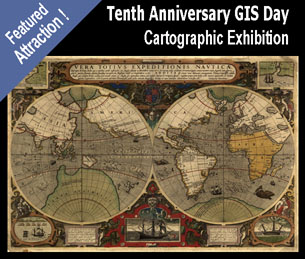
For GIS Day 2008 I drove up to the University of New Hampshire in Durham, New Hampshire to man a booth advertising our Department. This is the 10th year that UNH has hosted GIS Day activities (and my second year attending). The staff honored Mike Routhier with a glass clock for his decade of organizational success. Interestingly, I met Mike's father who had volunteered to drive the van that shuttled attendees from Morse Hall to the guest parking lot. Very pleasant gentleman and very proud of his son.

As usual it was a good turnout, although a slightly younger crowd. I recall speaking to more high school groups last year. This year I spoke to mostly middle school groups. I took posters by three of my students to show off (thanks to Jim, Jen and Bill Sr.), although I found myself explaining what an "undergrad" is more often than the GIS projects I showcased. One student was very interested in the quality of food on campus.

I also met up with two of our alums, both of whom made a point of stopping by to say hi. One works for GeoVantage - Dan Shinnick - and the other for Pictometry - Matt Deal. Very friendly people. They pushed their products, I pushed my students (for internships). It all works out very well.

Monday, September 29, 2008

Latinos in Scotland

I am writing this post a little late after our trip, but better late than never.

Just before the start of the school year, my wife and I made a 10-day trip to Scotland. She was presenting at an invitation-only conference in Glasgow (I wasn't invited but came along anyway).

We decided to document our trip in "realtime" (or close to it) by maintaining a 'geo-blog' of our travels for friends and family back home. This was an interesting - and time consuming - experiment. Scotland is a 21st century country (technically it is part of the UK, but the relationship is complicated), but it is also a still a rural country. Finding a stable Internet connection was almost always a challenge.


View Larger Map

An interesting thing about the state of online maps and directions. We discovered - the hard way - that Google Maps consistently underestimates travel times in Scotland. By contrast, Multimap (a British product) provides much more accurate estimates of travel time. Google has a national bias (surprise, surprise), or at least it doesn't take into account the unique quality of British roads or hapless American tourists trying to drive on the left side of the road. The difference was significant and we nearly missed a crucial connection on a car ferry. Luckily, the Scottish people are very forgiving.

Edinburgh is suitably beautiful and romantically Gothic - thick walled castles on craggy peaks dripping with damp and history. The newer buildings (those less than 300 years old) are still black and sooty from the city's coal-fired past.


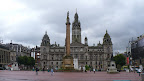
We were warned that Glasgow would be a gritty contrast (and a waste of time), but I found it to be easily as engaging as Edinburgh. I spent 3 full days walking that city. Where Edinburgh is a beautifully preserved museum, Glasgow is a living, breathing, frenetic metropolis. Many of the buildings are products of the city's wealthy heyday - the mid to late 19th century. High Victorian architecture and a strong Gothic revival - flying buttresses, extraordinary gargoyles and grotesques, incredibly carved, multi-hued stone. And inside and all around this 19th century architecture flows the modern day Scotland - well dressed people occupied with modern pursuits. Lots of good 'ethnic' restaurants too.


Modern day Scotland is a bundle of contrasts. Our visit to Eilean Donan, one of the most beautiful and charismatic castles, provided a jarring example. While the local guide (dressed in full kiltish reglia) explained the fairytale-like saga of clan battles and rediscovered histories, the reality is that much of the surrounding lands are now owned by Saudi families (why, I don't know).


The Highlands were breathtaking. Treeless and green. The Highlands are a region of long, unbroken views, low skies, and steep-sided giants. "Moody" is a cliche description I've often heard, but now I understand. It's not just the constant damp and cloudiness, it's also the consistently unpredictable light. Clouds and mist move and shift with eerie speed.


Must go back.